Industrial skill development in India is undergoing a structural shift. As manufacturing, infrastructure, and fabrication sectors expand, organizations face a continuous challenge: how to develop technically competent, safety-aware workers at scale without compromising training quality or operational stability.
Traditional training models are increasingly strained by safety risks, resource constraints, and inconsistent learning outcomes. This has led training institutions, industries, and policymakers to explore immersive learning and simulation-based training as a prawctical response to modern workforce demands by Seabery.
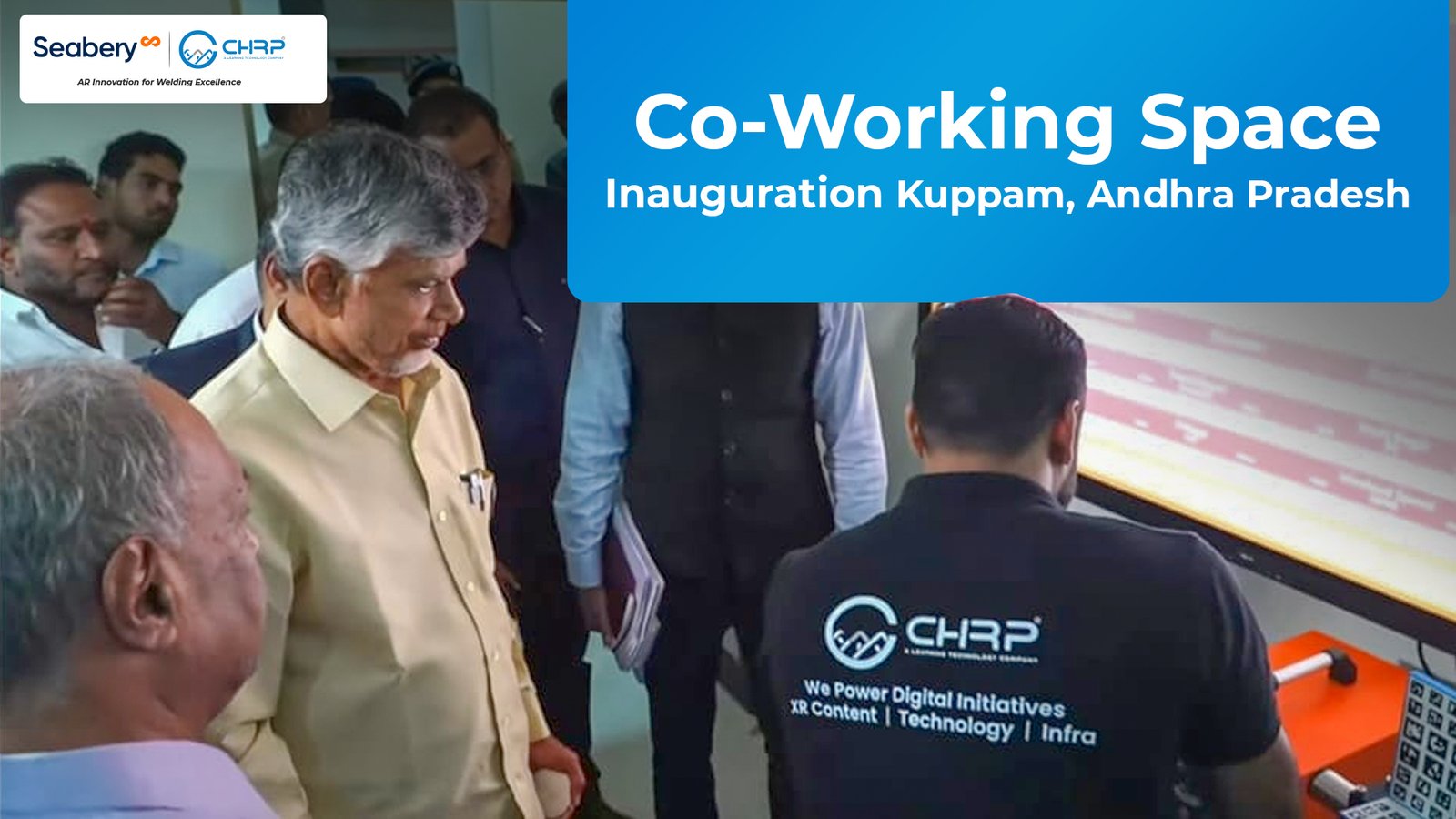
This approach was recently demonstrated during the Kuppam Co-Working Space inauguration in Andhra Pradesh, an initiative attended by the Honourable Chief Minister, Sri Nara Chandrababu Naidu Garu, which highlighted the growing role of technology-enabled learning environments in regional skill development.
The Broader Context: Skill Infrastructure and Technology Adoption
Innovation and co-working spaces are no longer limited to entrepreneurship and startups. Increasingly, they are being positioned as skill development and capability-building hubs, supporting collaboration between government bodies, training providers, and industry.
Recently inaugurated Kuppam Co-Working Space reflects this direction—serving as a platform to explore how modern training technologies can complement existing education and skill initiatives. As part of the event, welding simulation technology was demonstrated to illustrate how immersive learning tools can enhance technical training while addressing safety and scalability concerns.
While such demonstrations create awareness, the real value of these technologies lies in their ability to solve persistent training problems across industrial ecosystems.
Core Challenges in Industrial and Welding Training
-
Safety Risks During Early Skill Acquisition
Welding training exposes beginners to heat, sparks, fumes, and equipment hazards. For training providers, ensuring safety while allowing sufficient hands-on practice is a continuous challenge.
-
High Material and Operational Costs
Live welding practice requires consumables, energy, equipment maintenance, and supervision. These costs limit training frequency and scalability, particularly in large skill development programs.
-
Inconsistent Training Outcomes
Skill acquisition often varies significantly between learners due to differences in instruction quality, practice time, and assessment methods. This inconsistency affects employability and workforce readiness.
Immersive Learning as a Practical Training Solution
Immersive learning addresses these challenges by enabling learners to practice technical skills in simulated, controlled environments before working on real operations.
Rather than replacing traditional training, simulation-based learning strengthens it by:
- Allowing risk-free skill practice
- Standardizing learning experiences
- Providing measurable performance data
- Reducing dependency on physical resources during early training stages
This approach is particularly effective for welding, where precision, consistency, and safety are critical.
Welding Simulation Technology: How It Solves Real Training Problems
Welding simulation systems replicate real welding processes using advanced software, sensors, and performance analytics. Trainees can practice techniques repeatedly while receiving immediate, objective feedback.
Key problem-solving advantages include:
- Safety: Learners develop foundational skills without exposure to live welding hazards.
- Efficiency: Reduced material consumption and equipment wear
- Consistency: Standardized training scenarios across batches and locations
- Assessment: Data-driven evaluation of torch angle, speed, arc length, and accuracy
By the time learners transition to live welding, they are better prepared, more confident, and less prone to errors.
As industries place greater emphasis on compliance, safety, and productivity, training systems must evolve to deliver reliable and measurable skill outcomes. Immersive learning contributes to this evolution by transforming training from a resource-intensive activity into a structured, data-supported process.
The demonstration of welding simulation technology at the Kuppam initiative reflects a broader shift toward technology-enabled skill infrastructure, where training quality, safety, and scalability are treated as interconnected priorities.
Industrial skill development today requires more than increasing training capacity it requires improving training effectiveness. Immersive learning and welding simulation technologies address long-standing challenges in safety, consistency, and assessment, making them a practical addition to modern training ecosystems.
As India continues to strengthen its manufacturing and infrastructure sectors, the integration of simulation-based learning within skill development frameworks will play a key role in preparing a workforce that is not only trained but truly work-ready.