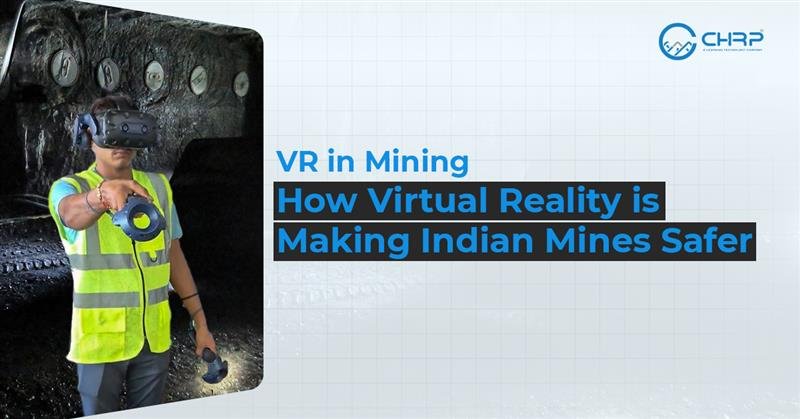
The mining industry has always been rated among the most difficult to operate in, where risk and complexity coexist. Despite technology and legislation being brought into the industry to make mine sites safer and more manageable, mine sites-particularly those underground are still filled with dangers to people who are working there. Against this background, the application of VR technology in mine sites can be seen to fill the knowledge and actual application gaps in mine sites.
Reality of Risk in Mining Operations
Mining sites present unpredictable environments. It can be open-cast or underground mining. In these environments, employees work around heavy machinery, geological instability, and time-critical decision environments. Classroom learning like, learning from written manuals, or learning from occasional site visits can hardly simulate these environments.
Some of the most popular obstacles experienced by the mining workforce include:
- Challenges in visualizing potential dangers underground
- Limited opportunity to practice emergency responses safely
- Inconsistent safety behaviour according to experience level
- High risk in early days after equipment start-up
- Lack of preparation for low-probability, high-impact
This is the point where the VR mining training introduces a fundamentally different learning approach.
Why VR in Mining Training is a Game Changer?
Virtual Reality gives mineworkers a reality of working conditions. They are not informed about dangers; instead, trainees observe dangers in virtual reality-training by observation and action and bearing the consequence.
Contrary to passive learning mediums such as watching videos or lectures
- Uses multiple senses
- It promotes active decision making
- Encourages proper safety practice by repetition
- Develops muscle memory for critical scenarios
VR minimizes the learning curve and improves awareness of the situation even before operatives are introduced in operational areas by simulating real mine environments.
Underground Mining Safety Through VR Simulations
Virtual Reality applied in safety training for underground mining enables the training subject to face situations such as:
- Collapse due to roof and sidewall instability
- Gas leaks, oxygen-deficient environments
- Malfunctioned ventilation
- Escape routes that are too narrow in case
- Communication breakdowns occurring
Trainees learn how to recognize the signs, respond correctly, and stay calm under pressure through the VR modules developed under the CHRP-INDIA. It helps the employees learn effectively.
Behavioural Safety and Decision Making in Mining
Many mining disasters are not the result of the failure of machinery but the decisions taken by humans under stress circumstances. VR training is effective because the program is based on behavioural safety.
In the VR environment, employees are subjected to conditions where:
- Cutting is associated with poor results
- Neglecting safety procedures leads to simulated incidents
- Correct decisions are reinforced via guided feedback
It helps change safety behaviour by exposing workers to what can be resulted from unsafe behaviour in a risk-free manner. Eventually, it leads to a more entrenched safety culture due to reduced complacency.
Driving Simulations on Mining Sites
Another major hazard area in mining is heavy vehicle driving. This includes dumper trucks, loaders, and other transportation vehicles that work under difficult conditions, with low visibility and frequent interactions with people.
The following are activities that VR driving simulation for the mining industry helps the driver carry out:
- Handling irregular and sloping topography
- Blind spots near large vehicles
- Reacts to sudden obstacles or equipment failure
- Collisions involving vehicles and construction equipment that pose a threat due
- Operating in low-light and different weather conditions
Using VR allows the workers to gain confidence and experience before working with the real equipment, thus reducing the accident risk when they begin operating.
CHRP-INDIA and MCL: Enhancing Mining Safety With Technology
The collaboration between CHRP-INDIA and Mahanadi Coalfields Limited, is the beginning of the modernization process in miner safety training in the Indian context. Here, training is conducted in VR, and orientations are not learning-centric but operation-specific.
The following are the key objectives of this initiative:
- Raising awareness of hazards to mine workers
- Decreasing training-related incidents
- Training to be prepared in times of disasters
- Standardization of safety procedures across multiple sites
Designs for VR Mining Training Programs by CHRP-INDIA
CHRP-INDIA’s solutions based on VR are developed with direct inputs from the industry, and their relevance and realism are not in doubt. Every module within these solutions has been developed taking into consideration real-life processes and protocols within mines.
Training environments include:
- Underground hazard detection and response
- Emergency evacuation drills
- Equipment operation safety
- Simulations of driving and material handling
- Familiarity with site
Benefits for VR in Mining Training
The organizations that use VR technology in mining report several benefits:
- Faster onboarding time for new staff
- Enhanced safety procedure retention
- Minimized operational disruptions
- Increased confidence levels in the workers
- Increased compliance with safety rules
VR allows for repeated exposure to risk scenarios without posing any danger to the individual and is useful in ensuring consistency in training for large groups of workers.
With the increase in mining capacity and governmental pressures regarding mining, mining education and training must go beyond the norm. Virtual Reality in mining provides a scalable, effective, and progressive solution.
VR is not replacing experience: VR is accelerating experience: safely.
Conclusion
Mining safety requires more than just education; it requires preparedness. With VR in mining safety education, organization’s prepares their employees in advance before they are faced with the realities of the mines.
CHRP-INDIA’s collaboration with MCL highlights how immersive learning helps change safety culture for underground hazards, driving factors, and behaviour-related safety.
As developments for smarter and safer operations take shape in the industry, a future for VR-based training remains assured in this sector.
Contact CHRP-INDIA to start training your workforce in virtual environments and let them experience and learn before stepping into the real work.