The oil and gas industry operates in some of the most hazardous, asset-intensive, and regulation-driven environments in the world. From offshore platforms to refineries and pipeline networks, operational precision and workforce competency directly impact safety, uptime, and profitability.
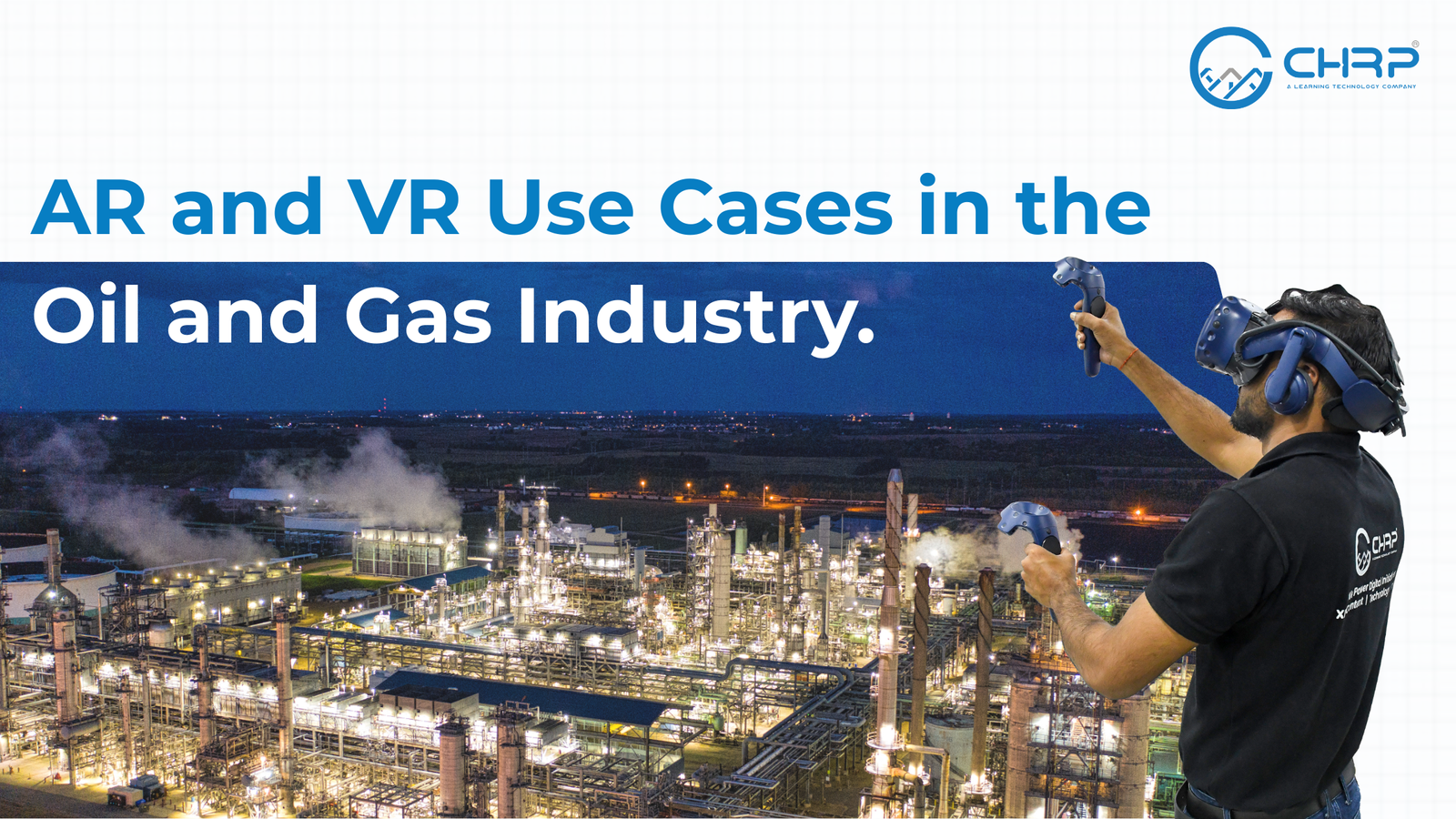
This is where AR and VR use cases in the oil and gas industry are redefining training, maintenance, inspection, and risk management.
Augmented Reality (AR), Virtual Reality (VR), and Extended Reality (XR) technologies are no longer experimental. They are becoming core components of digital transformation strategies across upstream, midstream, and downstream operations.
This article explores how AR and VR are transforming oil and gas operations – and how immersive learning solutions from CHRP-INDIA are helping organizations improve safety performance and operational efficiency.
Immersive training in oil and gas allows employees to practice procedures in realistic, simulated environments – without exposing them to actual danger.
Top AR and VR Use Cases in the Oil and Gas Industry
-
VR Safety Training for High-Risk Environments
One of the most impactful applications is VR safety training for oil and gas.
Workers can experience:
- Fire and explosion scenarios
- Gas leak identification
- Confined space entry procedures
- Emergency evacuation drills
- Hazard identification simulations
Instead of passive learning, VR enables active decision-making under pressure. This improves retention, response time, and hazard awareness.
Organizations using VR training report:
- Reduced incident rates
- Faster onboarding
- Better compliance adherence
At CHRP-INDIA Pvt. Ltd., immersive safety simulations are designed to replicate real-world oil and gas operational conditions – ensuring workforce readiness before field deployment.
-
Virtual Reality for Offshore Oil Rig Training
Offshore platforms are high-cost and high-risk environments. Sending trainees to live rigs is expensive and logistically complex.
Virtual reality for offshore oil rig training enables:
- Equipment handling practice
- Drilling process simulations
- Emergency response training
- Lockout-tagout procedures
- Heavy machinery operation familiarization
This reduces the need for physical site exposure while ensuring procedural mastery.
Immersive simulations significantly reduce training costs compared to traditional field-based programs.
-
AR-Based Maintenance and Remote Assistance
AR in oil and gas industry maintenance operations is transforming how field technicians work.
With AR-enabled smart devices, technicians can:
- View step-by-step digital overlays on equipment
- Access real-time data while performing repairs
- Connect with remote experts for troubleshooting
- Reduce human error in complex maintenance tasks
This is particularly useful for:
- Refineries
- Pipeline systems
- LNG terminals
- Pumping stations
AR-based remote assistance minimizes downtime and accelerates issue resolution.
-
AR Solutions for Pipeline Inspection and Asset Monitoring
Pipeline integrity is critical for safety and environmental protection.
AR inspection solutions in oil and gas allow field engineers to:
- Visualize underground pipeline layouts
- Overlay digital schematics on physical infrastructure
- Identify potential corrosion or structural weaknesses
- Improve inspection accuracy
Combined with predictive maintenance technology, AR enhances decision-making speed and reduces costly shutdowns.
-
Immersive Learning for Workforce Upskilling
The oil and gas workforce is evolving. With aging experts retiring and new workers entering the field, knowledge transfer is critical.
Immersive learning in oil and gas companies bridges the skills gap by:
- Simulating real equipment operations
- Recreating rare but critical emergency events
- Enabling repeatable practice sessions
- Tracking performance analytics
Unlike static training modules, VR training measures behavioural response and decision accuracy.
CHRP-INDIA integrates immersive simulation with measurable learning outcomes, helping organizations move beyond theoretical instruction to experiential competence building.
How AR and VR Improve Safety in Oil and Gas
The biggest measurable benefit of AR and VR adoption is risk reduction.
Key Safety Improvements:
- Enhanced hazard recognition
- Improved emergency preparedness
- Reduced human error
- Higher compliance alignment
- Faster reaction time in crisis scenarios
In hazardous industries, even small improvements in response time can prevent catastrophic losses.
Business Benefits of AR and VR in Oil and Gas
Beyond safety, immersive technology delivers tangible ROI.
-
Reduced Downtime
AR-assisted maintenance decreases repair time and accelerates troubleshooting.
-
Lower Training Costs
VR reduces travel, instructor, and equipment usage expenses.
-
Faster Onboarding
New employees reach operational readiness quicker.
-
Standardized Global Training
Multisite companies can deploy consistent training modules across locations.
-
Digital Transformation Enablement
AR and VR align with Industry 4.0 and smart asset management strategies.
Why Oil and Gas Companies Are Partnering with CHRP-INDIA Pvt. Ltd.
CHRP-INDIA Pvt. Ltd. develops immersive learning and simulation-based training solutions tailored for industrial environments.
For oil and gas companies, this means:
- Custom VR safety simulations
- Equipment-specific operational training modules
- AR-based maintenance workflow solutions
- Scenario-based emergency response training
- Performance analytics-driven learning systems
Rather than generic VR content, CHRP-INDIA focuses on contextualized immersive environments that reflect real operational challenges.
The result: improved safety metrics, operational efficiency, and workforce confidence.
The Future of AR and VR in the Oil and Gas Industry
The adoption curve is accelerating.
In the coming years, expect:
- Wider deployment of AR smart helmets
- AI-integrated immersive simulations
- Digital twin integration with VR training
- Remote collaboration becoming standard practice
- Greater regulatory encouragement of immersive safety training
Organizations that adopt early will gain competitive advantage through safer operations and more resilient workforces.
Immersive technologies are redefining how oil and gas companies train, operate, and manage risk.
For organizations seeking to enhance safety performance, reduce downtime, and accelerate digital transformation, immersive learning is becoming a strategic necessity.
CHRP-INDIA Pvt. Ltd. stands at the forefront of this transformation, delivering industrial-grade immersive training solutions that align technology with real-world operational demands.