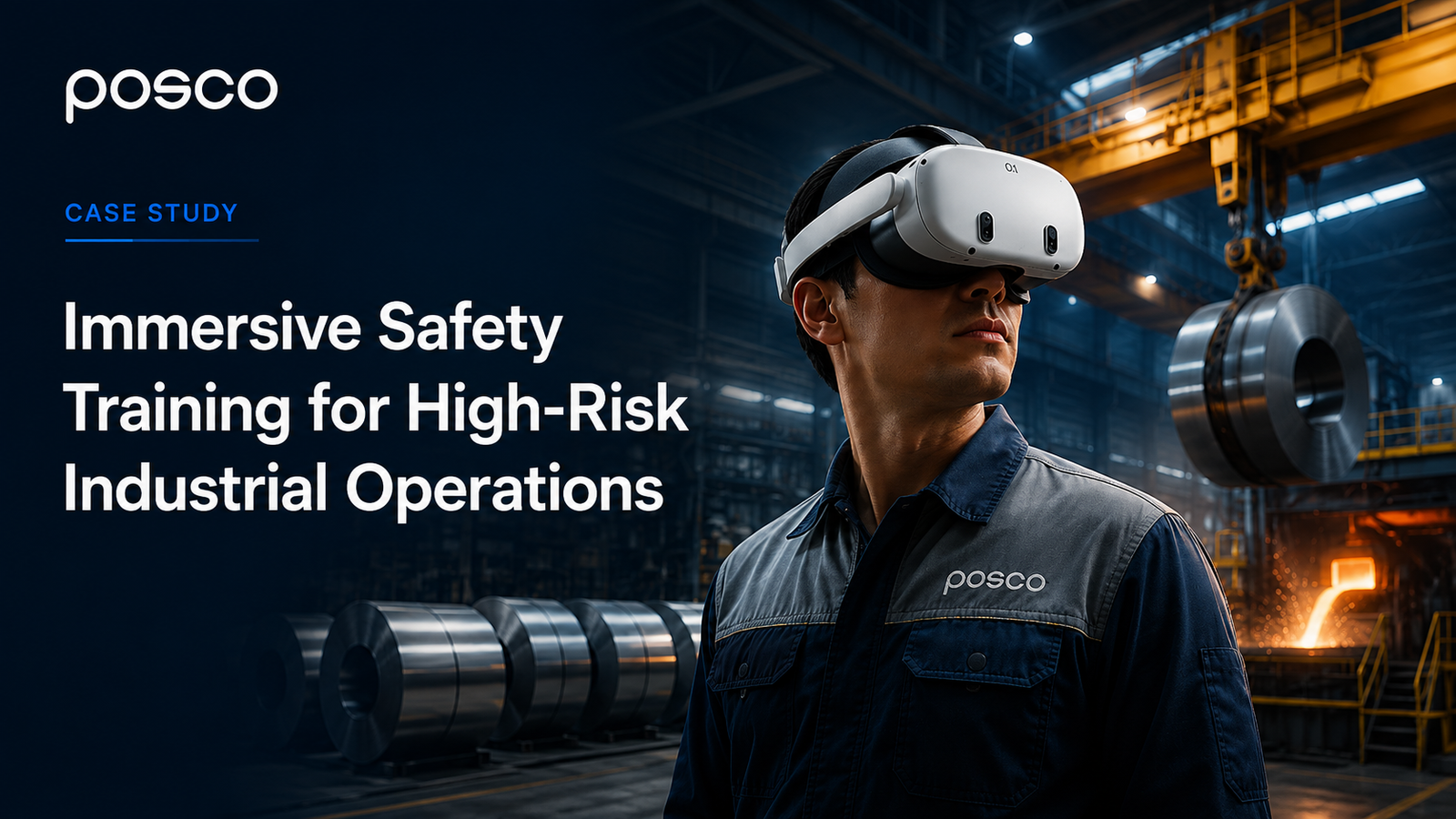
How CHRP-INDIA developed immersive learning experiences to strengthen safety awareness, procedural understanding and workforce readiness across critical industrial activities.
About Posco
POSCO is a global steel manufacturer operating large-scale industrial facilities where employees and contractors work around heavy machinery, electrical systems, elevated structures, confined spaces, hazardous materials and complex material-handling operations.
In this environment, workforce competency plays an important role in employee safety, equipment reliability and operational continuity.
The Challenge
Several high-risk activities within steel manufacturing are difficult to practise regularly in live working environments.
Traditional training can explain safety procedures, but it may not provide sufficient opportunities for employees to experience realistic conditions, make decisions or repeat critical tasks.
The key training areas included:
- Confined space entry
- Rooftop and scaffolding work
- Heavy metal coil handling
- Electrical isolation
- Fire emergency response
- Lockout and tagout
- Chemical tanker operations
POSCO required a safer and more consistent way to help employees understand hazards and practise approved procedures.
The Project Objective
The project aimed to convert safety-critical procedures into structured immersive learning experiences.
The training was designed to help employees and contractors:
- Recognise workplace hazards
- Follow procedures in the correct sequence
- Select and inspect appropriate PPE
- Practise decisions without physical exposure
- Understand the consequences of unsafe actions
- Build familiarity before entering live work areas
- Repeat activities where further practice was required
The immersive programme was developed to strengthen existing classroom and practical training, not replace it.
CHRP-INDIA’s Approach
CHRP-INDIA applied a safety learning and instructional design approach to convert approved procedures into realistic, interactive scenarios.
The approach included:
- Analysing each work activity
- Identifying hazards and critical safety steps
- Defining PPE and equipment requirements
- Mapping safe and unsafe decisions
- Designing guided practice scenarios
- Providing immediate corrective feedback
- Demonstrating the consequences of unsafe actions
- Enabling repeatable practice and assessment
Learners were required to inspect environments, identify risks, select equipment and complete procedures rather than simply watch demonstrations.
Immersive Training Areas Covered
Confined Space Safety
Training for work inside equipment, vessel tanks and pipelines, covering entry preparation, work permits, PPE checks, communication, hazard awareness and emergency procedures.
Working at Height
Rooftop and scaffolding scenarios covering PPE selection, harness inspection, safe access, anchorage points, lanyard attachment, tool safety and fall-hazard recognition.
Crane Operations and Coil Handling
Simulation-based training covering pre-operational checks, lifting plans, exclusion zones, load movement, team communication and the safe placement of heavy metal coils.
Electrical Work Standards
Training focused on electrical hazards, PPE, work-area preparation, isolation, verification, safe approach distances and compliance with approved procedures.
Fire Safety
Emergency scenarios covering fire-hazard identification, alarm response, evacuation routes, assembly points and appropriate action according to site procedures.
Lockout and Tagout
Training covering equipment isolation, hazardous energy identification, personal locking, group locking, lock and tag application, verification and safe equipment restoration.
Chemical Tanker Operations
Training for safe tanker positioning, pre-transfer inspections, PPE checks, hose connections, chemical verification, transfer monitoring, spill response and safe disconnection.
Project Outcomes
The immersive training programme supported measurable improvements in learning retention, workplace application and safety behaviour.
More than 30% Improvement in Training Retention
Post-training evaluation indicated stronger recall of safety procedures and improved understanding of the correct sequence of critical tasks.
30% Improvement in Daily Work Performance
Employees demonstrated better application of approved procedures and greater confidence when carrying out relevant workplace activities.
More Than 40% Improvement in PPE Practices
A greater proportion of employees began using PPE correctly and actively encouraged colleagues to follow the same safety requirements.
The project also supported:
- More consistent safety training
- Stronger hazard-recognition skills
- Improved understanding of unsafe actions and consequences
- Reduced dependence on operational equipment during initial training
- A reusable foundation for future assessment and refresher learning
From Training Completion to Safer Workplace Behaviour
The value of immersive safety training extends beyond course completion.
By placing employees in realistic scenarios, the programme allowed them to practise decisions before facing similar situations in live operations. Immediate feedback helped learners understand why each safety control was required and how incorrect actions could affect people, equipment and production.
The training also encouraged employees to take greater responsibility for safe working practices. Improved PPE use and peer guidance indicated that learning was beginning to influence day-to-day workplace behaviour rather than remaining limited to the training environment.
Conclusion
The POSCO project demonstrates how immersive learning can strengthen industrial safety training by converting procedures into practical, controlled and repeatable experiences.
Through scenarios covering confined spaces, working at height, crane operations, electrical work, fire safety, lockout and tagout, and chemical tanker operations, employees were able to build procedural understanding without being exposed to real workplace hazards.
The solution complemented existing training by helping employees recognise risks, practise critical decisions and apply safer behaviours in their daily work.
Explore Immersive Safety Training for Your Organisation