In industries like mining, construction, manufacturing, and heavy engineering, the performance of heavy equipment operators directly impacts safety, productivity, and operational efficiency.
However, many organizations today face a common challenge: operators are not fully prepared for real-world conditions.
Despite investing in training programs, gaps still exist. These gaps often lead to safety incidents, equipment damage, and inconsistent performance.
This is where simulation based training is changing the way industrial workforce training is delivered.
Understanding Skill Gaps in Heavy Equipment Operations
Operating heavy machinery is not just about handling controls. It requires judgment, awareness, and the ability to respond quickly in high-risk situations.
Some of the most common skill gaps include:
Limited Real-World Exposure
Operators are rarely exposed to critical situations such as equipment failure, unstable terrain, or emergency scenarios during training.
Inconsistent Training Quality
Training methods often vary across locations or trainers, leading to uneven skill levels within teams.
Low Confidence in High-Risk Situations
Even trained operators may hesitate or react incorrectly when faced with unexpected conditions.
Safety Awareness Gaps
A lack of practical safety experience increases the risk of workplace incidents.
Difficulty Adapting to Advanced Equipment
Modern machinery comes with digital systems and automation features that require a different level of understanding.
These gaps highlight a clear need for more practical and experience-driven training approaches.
Why Traditional Training Methods Are Not Enough
Most traditional training methods rely on classroom sessions or limited on-site exposure.
While they help build basic knowledge, they often fall short when it comes to real-world application.
- They do not simulate actual working conditions
- They offer limited opportunities for practice
- They cannot safely recreate hazardous situations
- They rely heavily on passive learning
As a result, operators may understand procedures but struggle to apply them effectively in the field.
What is Simulation-Based Training?
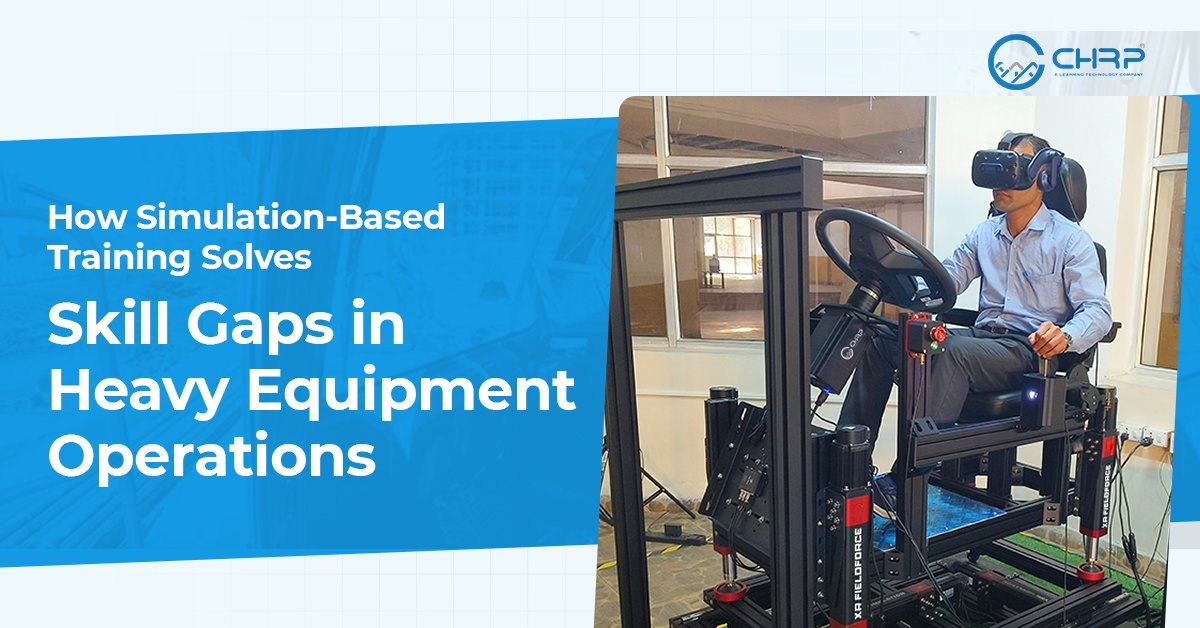
Simulation-based training uses immersive technologies such as Virtual Reality (VR), Augmented Reality (AR), and Extended Reality (XR) to replicate real operational environments.
Instead of learning through theory, operators learn by doing.
They can interact with equipment, experience real scenarios, and make decisions in a controlled and safe environment.
How Simulation-Based Training Bridges the Skill Gap
1. Safe, Risk-Free Practice
Operators can train in hazardous scenarios without any real-world consequences.
This allows them to make mistakes, learn from them, and build confidence before entering actual work environments.
2. Realistic Scenario-Based Learning
Simulation recreates real challenges such as:
- Equipment malfunction
- Sudden operational risks
- Environmental hazards
This prepares operators for situations they are unlikely to experience during traditional training.
3. Consistent Training Across Teams
Every operator receives the same training experience, regardless of location or trainer.
This ensures uniform skill development across the organization.
4. Faster Learning and Better Retention
Learning through experience improves understanding and memory retention.
Operators become more confident and capable in a shorter period.
5. Measurable Performance Insights
Simulation platforms can track:
- Response times
- Errors and decision patterns
- Task completion efficiency
This helps organizations identify gaps and continuously improve training outcomes.
6. Improved Safety and Reduced Incidents
When operators are better prepared, they make fewer mistakes.
This leads to safer workplaces, reduced downtime, and improved operational efficiency.
Why Industries Are Adopting Simulation-Based Training
Organizations are increasingly moving toward immersive training because it delivers clear business value.
It helps:
- Improve workforce readiness
- Strengthen safety practices
- Reduce operational risks
- Enhance overall productivity
More importantly, it provides a scalable way to train large teams without disrupting operations.
CHRP-INDIA Pvt Ltd: Driving Practical Training for Industrial Workforces
For organizations looking to move beyond traditional training, the choice of partner is critical.
CHRP-INDIA Pvt Ltd focuses on building practical, scenario-driven training solutions tailored for industrial environments.
What Sets CHRP-INDIA Apart?
Industry-Focused Approach
The solutions are designed based on real operational challenges across mining, construction, and manufacturing sectors.
Immersive Learning Expertise
By leveraging VR, AR, and XR technologies, CHRP-INDIA creates training environments that closely mirror real-world conditions.
Custom-Built Training Programs
Each solution is developed to match the specific equipment, processes, and safety requirements of the organization.
Scalable Deployment
Training programs can be rolled out across multiple locations while maintaining consistency and quality.
End-to-End Support
From design to implementation, CHRP-INDIA ensures a smooth transition to modern training methods.
Real-World Applications
Simulation-based training can be applied across various industrial use cases:
- Equipment operation and handling
- Safety and hazard awareness
- Emergency response training
- Maintenance procedures
- Site-specific operational training
These applications make it a practical solution for both new operators and experienced professionals.
Business Impact
Organizations that adopt simulation-based training often see:
- Faster onboarding of operators
- Improved safety performance
- Reduced equipment-related incidents
- More confident and capable workforce
Over time, this leads to stronger operational efficiency and better business outcomes.
Conclusion
Skill gaps in heavy equipment operations are not just a training issue. They are a business risk.
Traditional methods alone are no longer sufficient to prepare operators for today’s complex and high-risk environments.
Simulation based training offers a practical and effective way to close these gaps by combining real-world scenarios with safe, immersive learning.
With the right approach and the right partner, organizations can build a workforce that is not only skilled, but also confident and safety-focused.