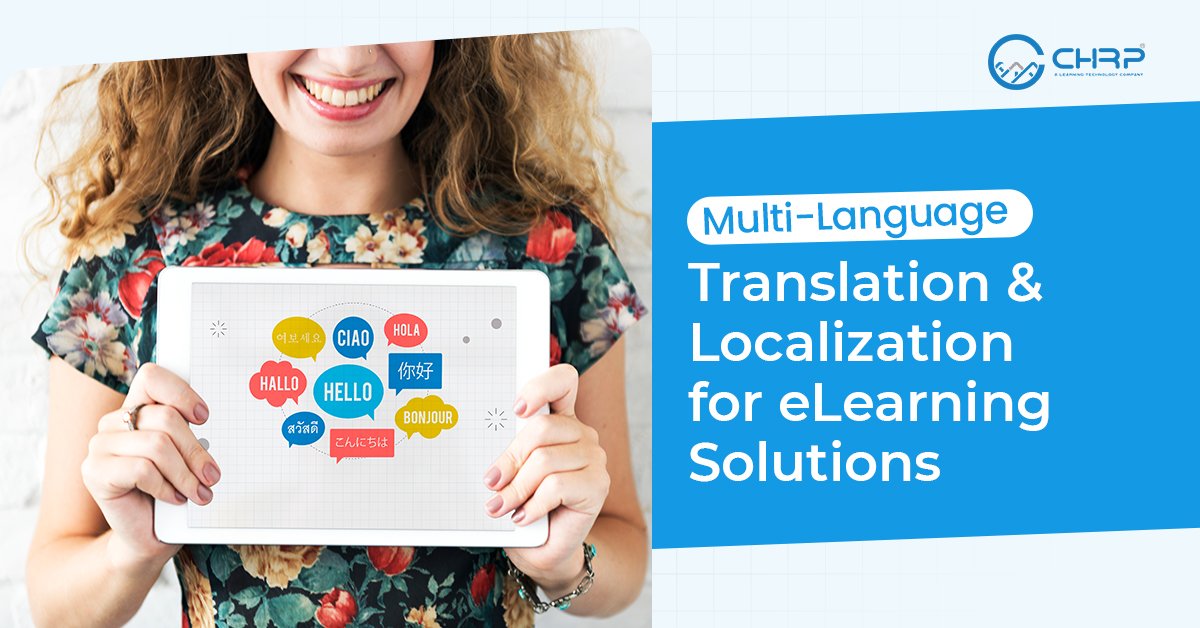
Modern businesses are no longer limited to a single country or a single language. Companies today train employees, partners, vendors, and customers across different regions where people speak different languages and follow different work cultures. This creates a major challenge in corporate training because a single-language course cannot effectively train a global workforce. Multi-language translation and localization help organizations solve this problem by making training content easier to understand, region-specific, and more engaging for learners.
Multi-language eLearning solutions are not just about converting English content into another language. Proper localization helps adapt the learning experience according to the learner’s language, culture, technical terminology, and regional requirements. This makes training more practical and effective for global teams.
Multilingual eLearning Improves Training Effectiveness
Many organizations invest heavily in training programs, but employees often struggle to understand the content when it is delivered in an unfamiliar language. This reduces learner engagement and affects training results. Multi-language localization helps employees understand concepts more clearly in their native language, making learning simpler and more comfortable.
When learners understand the content properly, training completion rates improve naturally. Employees become more confident while applying procedures, handling equipment, following safety protocols, or using enterprise software systems. This is especially important in industries where training accuracy directly impacts workplace safety and operational performance.
Translation Alone Cannot Solve Global Training Challenges
Direct translation often creates confusion in corporate learning programs. Technical words may lose their meaning, subtitles may not match voiceovers properly, and examples used in training may not relate to local learners. This affects the overall learning experience and reduces knowledge retention.
Localization helps solve these issues by adapting the complete learning content instead of simply changing the language. A properly localized eLearning course includes native language voiceovers, culturally relevant examples, localized technical terminology, synchronized subtitles, and region-specific scenarios. This creates a learning experience that feels natural for the learner instead of appearing like a translated course.
Multilingual Localization Helps Improve Safety and Compliance Training
Industries such as manufacturing, mining, engineering, healthcare, construction, and oil & gas require accurate training because even small misunderstandings can create operational risks. Employees must clearly understand safety instructions, machine operations, maintenance procedures, and compliance guidelines.
Multi-language eLearning solutions help organizations deliver safety and technical training more effectively by reducing language barriers. Learners can understand procedures more clearly and apply them correctly in real working environments. This improves workforce readiness and helps organizations maintain training consistency across multiple locations.
Multingual eLearning Supports Global Workforce Development
Global companies often face difficulties maintaining the same training standards across different countries. Localization helps organizations deliver consistent training while still adapting the learning experience for regional audiences. Employees across locations receive the same knowledge, but in a format that is easier for them to understand.
This approach also helps businesses scale training programs faster during global expansion. New teams can be trained efficiently without completely rebuilding training programs for every region.
How CHRP-INDIA Supports Multi-language eLearning Solutions
CHRP-INDIA provides multilingual translation and localization solutions for corporate eLearning programs across industries. The focus is on creating learning experiences that are easy to understand, regionally adapted, and technically accurate for global learners.
The company supports multilingual eLearning development through language translation, localization, subtitle integration, multilingual voiceovers, LMS-compatible learning solutions, and industry-specific training adaptation. These solutions help organizations improve learner engagement while maintaining consistency across global training programs.
CHRP-INDIA works with organizations that require scalable multilingual training solutions for technical, industrial, compliance, onboarding, and enterprise learning programs.
Final Thoughts
Multi-language translation and localization have become an essential part of modern corporate training. Employees learn better when training content is delivered in their own language and adapted to their work environment. Proper localization improves understanding, increases learner engagement, and helps organizations build more effective global training programs.
Businesses that invest in multilingual eLearning solutions can improve workforce training quality while supporting global growth more efficiently.
To know more about multilingual corporate training and localization services, visit the CHRP-INDIA eLearning Solutions.